
We work at the spatial biology-technology interface.
To understand chromatin ↔ synapse communication in the mammalian brain.
Our Research
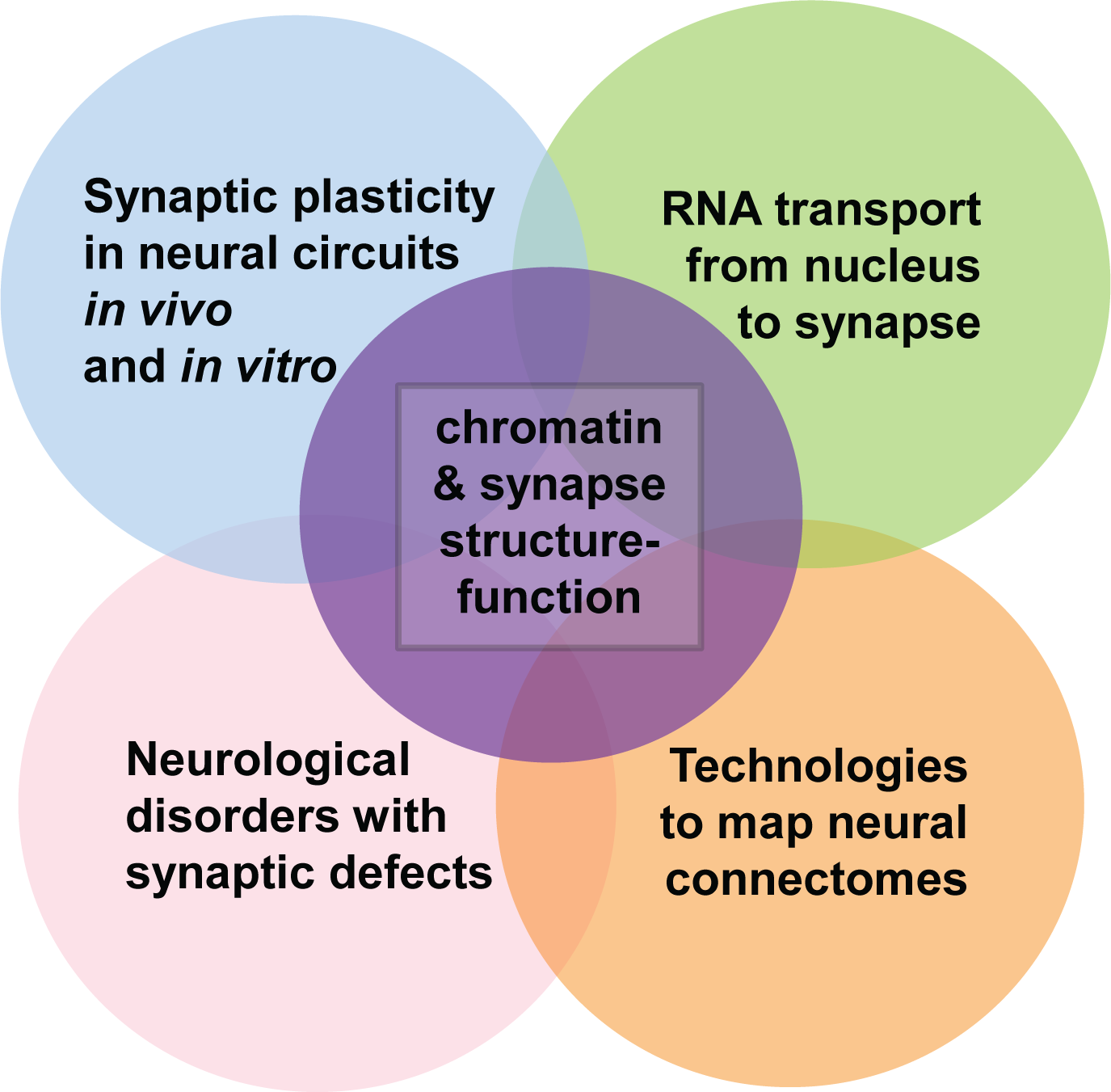
The Cremins Laboratory works at the spatial biology-technology interface to investigate the structure-function relationship of connections across the scales of chromatin, synapses, and circuits in the developing and diseased mammalian brain.
Neurons exhibit elaborate structures at multiple scales, including diverse long-range axonal projections to form circuits, a range of complex dendritic spine geometries at the synapse, and the folding of the 10 nm chromatin fiber into compartments, topologically associating domains (TADs), and long-range looping interactions in the nucleus.
We have thus far focused on the nucleus to elucidate chromatin’s higher-order folding patterns at kilobase-resolution during neural lineage commitment, maturation, activity stimulation, and in neurological disorders. In mammals, the genetic sequence is >2 meters when stretched out end-to-end. It is folded into exquisite structures to fit into a nucleus roughly the size of a pin’s head. At the lab’s inception, it remained unclear how genomes are folded in a cell type-specific manner below the resolution of a Megabase, and whether and how higher-order folding could deterministically influence genome function. Our major contribution has been to provide early foundational insights into the genome’s structure-function relationship. We have elucidated how chromatin works through long-range mechanisms to govern the establishment of new gene expression, repeat instability, and replication origin firing patterns when mammalian cells transition states in the healthy and diseased brain.
Lab News
Kenneth Pham gave a great talk on his work to the UPenn Genetics, Epigenetics, and Gene expression communities on his work in heterochromatin mosaicism in fragile X syndrome.
March 14, 2025
Congratulations to MSTP student Han-Seul Ryu for the acceptance of her collaborative paper with the Anguera Lab entitled B cell stimulation changes the structure and higher-order organization of the inactive X chromosome in Cell Reports. Amazing job Han-Seul!
February 5, 2025
Congratulations to PhD student Rohan Patel for the acceptance of his paper entitled " FISHnet: Detecting chromatin domains in single-cell sequential Oligopaints imaging data" in Nature Methods. https://www.biorxiv.org/content/10.1101/2024.06.18.599627v1
January 28, 2025
Congratulations to clinical fellow and postdoc alum Michael Guo on the publication of his paper entitled 'Polygenic burden of short tandem repeat expansions promotes risk for Alzheimer's disease' in Nature Communications. https://www.nature.com/articles/s41467-025-56400-0
January 28, 2025
Sweety Meel joins us from Dimple Notani's lab (https://swati.nipgr.ac.in/Scientist/SWEETY%20MEEL) as a new postdoctoral research fellow. Welcome Sweety!
January 13, 2025
Javed Chitman joins us from Florida State as a new postdoctoral research fellow. Welcome Javed!
January 6, 2025
Skenlanda Marseille joins our lab full time for a post-bacc internship to continue her long-time work in our SEEDs program. Welcome, Skenlanda!
January 6, 2025
Congrats to our alum Dr. Jonathan Beagan who has now joined Precede Bio as a computational scientist. He presented his work in a poster and panel at SABCS to ascertain if chromatin signatures can be detected in liquid biopsy and used to diagnose intractable breast cancer. https://www.instagram.com/p/DD4zTogxEqK/
December 22, 2024
Congratulations to our alum Dr. Ji Hun Kim who has started his own laboratory at KAIST and just won his first independent grant.https://www.instagram.com/p/DDkVZRaypWc/
December 14, 2024
Congratulations to PhD candidate Rohan Patel – he is awarded an NIH fellowship for his work to computationally explore chromatin patterns and mechanisms of loop extrusion in sequential oligopaints imaging data.https://www.instagram.com/p/DDPftAlxE86/?img_index=5
December 6, 2024
Katelyn Titus defends their PhD with an unbelievable 11 papers, congratulations, Dr. Titus! We have loved our time working with you and can't wait to share your achievements with our community.
December 5, 2024
Ali Nikish defends her PhD, congratulations, Dr. Nikish! We are all proud of you!
December 4, 2024